
You Never Really Stop Being Their Child
There is something slightly absurd about being in your forties and still being treated like you need supervision.
You can manage your career, your money, your home, your travel and most of the decisions that come with being an adult, and yet a conversation with your parents can still end with a reminder to eat properly, sleep on time or carry a jacket. It can be annoying, particularly when you haven’t asked for advice and are perfectly capable of making your own decisions. And yet, there is something comforting about knowing that being an adult doesn’t mean you have to give up being looked after. You can run your own life and still have someone worrying about whether you’ve eaten.
I don’t think that ever completely goes away.
What does change is that somewhere around this age, you start noticing that your parents are changing too. The people who once seemed to know exactly what to do don’t always have the answers anymore. And without anyone announcing it, the relationship starts becoming a little more interchangeable.
Then They Start Needing You
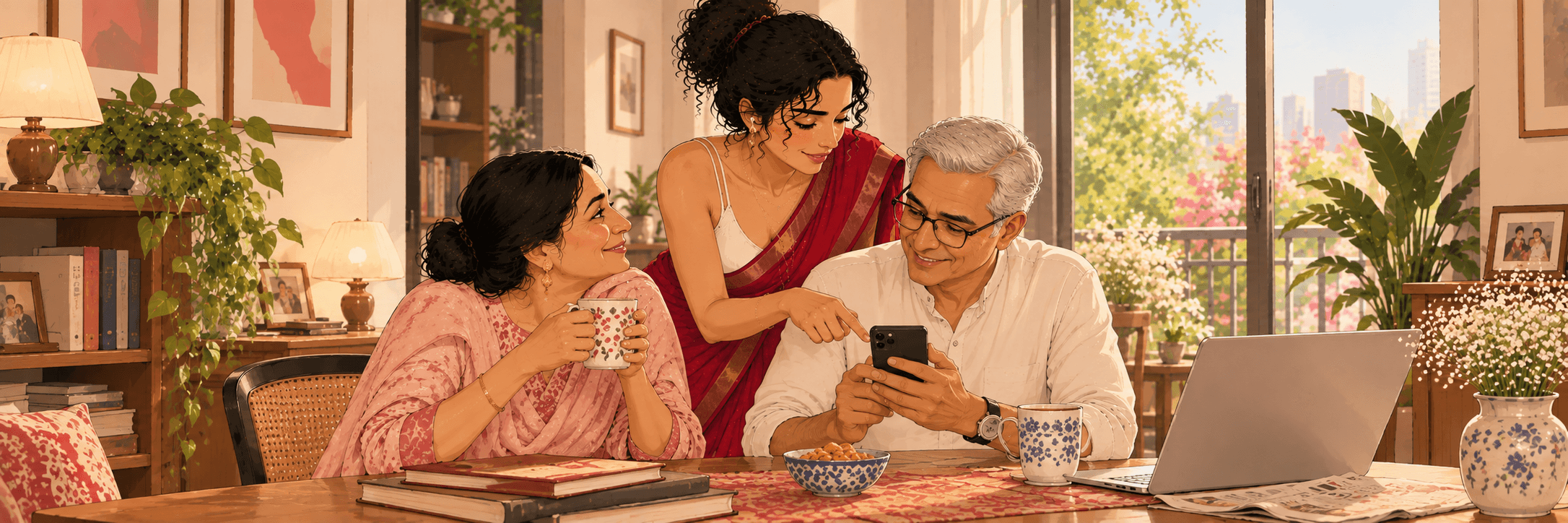
It doesn’t necessarily happen in dramatic ways. Sometimes it’s as simple as your father asking you to figure out something on his phone because he cannot understand why WhatsApp has moved something again. The man who taught you mathematics now needs you to explain the Instagram algorithm to him, and neither of you is particularly sure how you got here.
With mothers, the dependence can look very different.
The women who dressed us up like divas when we were little, who knew exactly what looked good on us and often had very definite opinions about what we should wear, can reach a point where they start doubting their own fashion choices. Your mother might find something she loves but hesitate to wear it because she’s unsure whether she can pull it off. Suddenly, you’re the one encouraging her to wear the outfit, telling her she looks good and reminding her that she doesn’t need to second-guess herself.
The woman who spent years building your confidence can sometimes need you to lend her a little of it back.
She might also ask whether she handled a conversation correctly, whether she said the right thing or whether she’s overthinking something. It can be strange to watch because these are the people who spent so many years making us feel like they knew everything.
And then you realise they don’t know everything. Neither do we, of course, but we’ve grown into a different world, and there are things we understand that they are still trying to figure out.
Sometimes You Are the Adult, Sometimes They Are
The funny thing is that this isn’t really a role reversal. It isn’t as though one day you become the parent and they become the children. The roles keep switching.
You can spend an afternoon helping your mother figure something out and then have her tell you that you’re not eating enough. You can explain something to your father and then have him give you advice about something you absolutely did not ask him about. You can be the person they rely on for practical help and still be the child whose life they worry about.
And sometimes the dependence isn’t even about needing help. It is simply about wanting reassurance. Your mother may still be the person you call when you’ve had a terrible day. Your father may still be the person whose opinion you want when something important happens.
The relationship becomes less about who is responsible for whom and more about the fact that you are now two adults who need each other in different ways.
You Grow Older Together
The world is evolving at a pace that can be difficult to keep up with, and while we may adapt to some of those changes more easily, our parents sometimes need longer to find their footing. Technology is an obvious example, but it isn’t just about phones and apps. Social expectations change, relationships look different, and the rules they grew up with don’t always apply to the world we live in now.
And just as they once helped us make sense of things we had never encountered before, we now help them navigate unfamiliar territory. They were there when we were trying to understand puberty, negotiate our first jobs, make sense of our first relationships and work out what being an adult was supposed to look like. We went to them because they had more experience of the world than we did. Now, in some areas of life, that experience belongs to us.
I think this is one of the stranger privileges of getting older. You begin to see your parents not just as your parents, but as people who are also figuring things out. They have insecurities, uncertainties and moments when they need someone to tell them that they’re going to be fine.
And yet, at the end of all this, they are still your parents.
You can be the person they call when they don’t know what to do and still call them when you don’t know what to do yourself. You can be completely independent and still need the particular kind of comfort that only your parents can give you.
Sometimes they are the adults in the room. Sometimes you are. And sometimes, after all these years, you are still just their kid.


Leave a Reply